What is reliability?
To check whether the system in terms of reliability. Reliability means the quality of a system is being trustworthy or of performing consistently well.
Problem-1:
- Downtime for the mill is estimated at $5 per min. (Whenever the machine will not working, we will have a loss of $5).
- The direct one-site cost of the repair person is $15 per hour.
- It takes 20 min to change one bearing, 30 min to change two bearing and 40 min to change three bearings.
- The bearings cost $16 each.
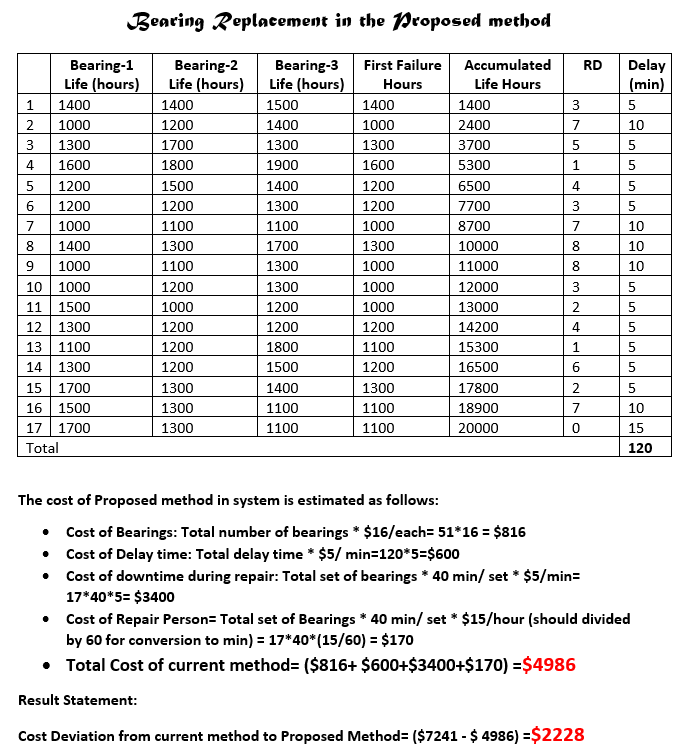
- A proposal has been made to replace all three bearings whenever a bearing fails. (we will simulate this proposal)
- 20,000 Bearing-hours will be used as the measure of performance.
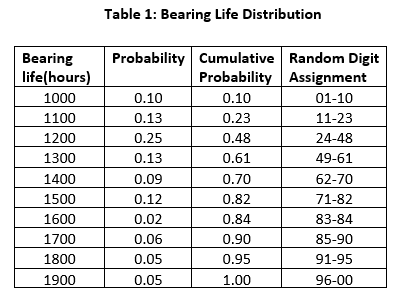
The cumulative distribution of the function of life of each bearing is identical, as shown in the table-1.
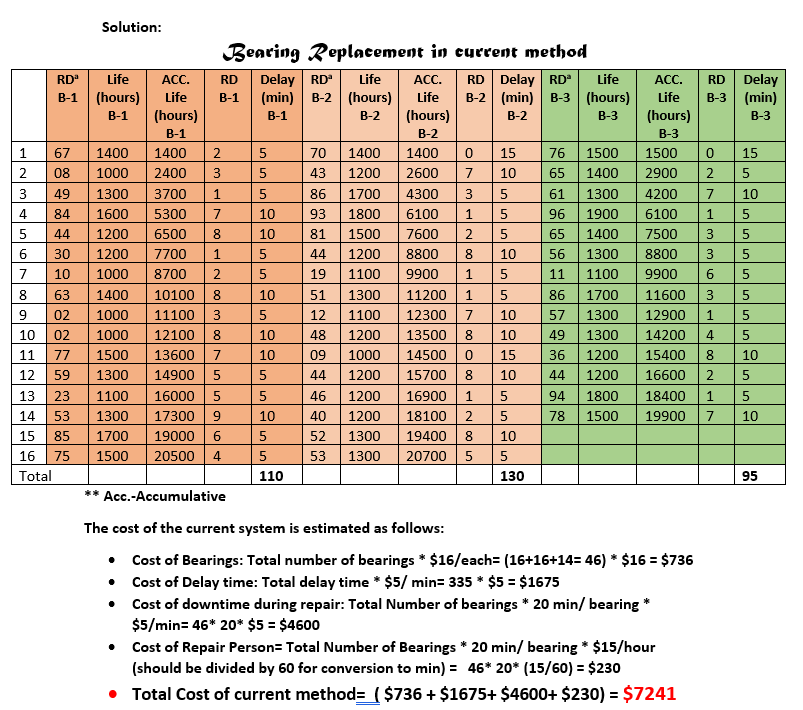
Random Digit for bearing-1: 67,08,49,84,44,30,10,63,02,02,77,59,23,53,85,75,85,05
Random Digit for bearing-2: 70,43,86,93,81,44,19,51,12,48,09,44,46,40,52,53,29
Random Digit for bearing-3: 76,65,61,96,65,56,11,86,57,49,36,44,94,78,63,21,23,51
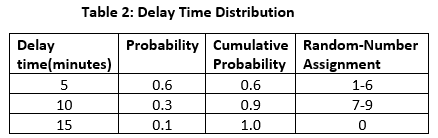
The delay time of the repair person’s arrival at the milling machine is also a random variable with the distribution given in table 2.
Random digit for bearing-1: 2,3,1,7,8,1,2,8,3,8,7,5,5,9,6,4,3,5
Random Digit for bearing-2: 0,7,3,1,2,8,1,1,7,8,0,8,1,2,8,5,9,7
Random Digit for bearing -3: 0,2,7,1,3,3,6,3,1,4,8,2,1,7,3,9,0,6
Random Digit for proposed method: 3,7,5,1,4,3,7,8,8,3,2,4,1,6,2,7,0,5