Monte-Carlo Simulation Technique
- It is an experiment of a chance.
- Uses random number and requires decision making under uncertainty
To understand the Technique, it breaks down in 5 Steps
- Establishing probability distribution
- Cumulative probability distribution
- Setting random number intervals
- Generating random number
- To find the answer of the question asked using the above 4 steps

Simulate the dentist’s clinic for four hours and find out the average waiting time for the patients as well as the idleness of the doctor. Assume that all the patients show up at the clinic at exactly their scheduled, arrival time starting at 08:00 am. Use the following random number to handle the above situation: 40, 82, 11, 34, 25, 66, 17, 79
Problem Statement:
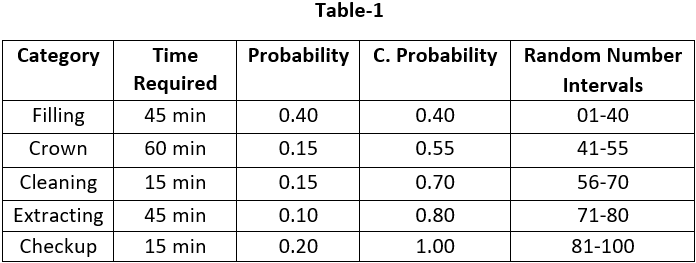
John is a dentist who schedule all his patients for 30 minutes appointments. Some of the patients take more than 30 minutes depending on the type of dental work to be done. The following summery shows the various categories of work, their probabilities and the time actually needed to complete the work
Solution
At first, we have to do probability distribution.
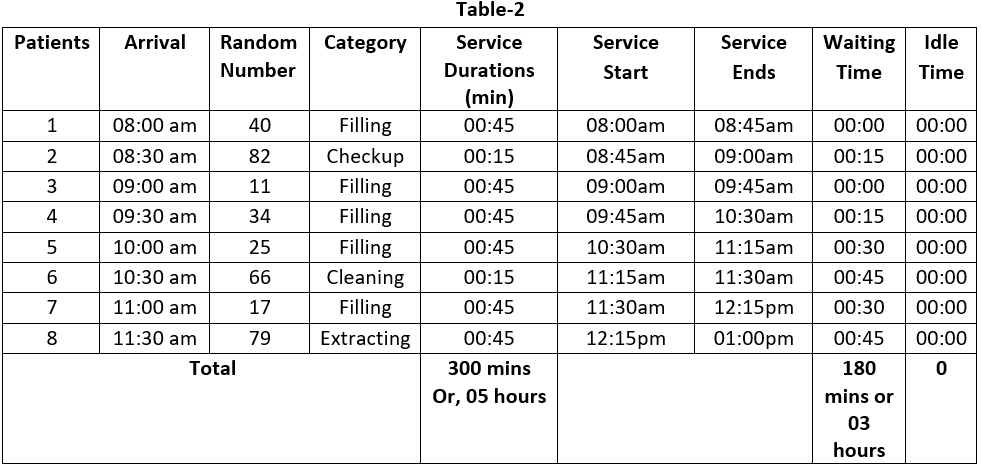
- Average waiting time: 180/8 = 22.50 mins
- Average service time: 300/8 = 37.5 mins
- Idle time of Dentist: 0 mins
- Utilization of the system: 1 or 100%
Problem-2 (Do it yourself.)
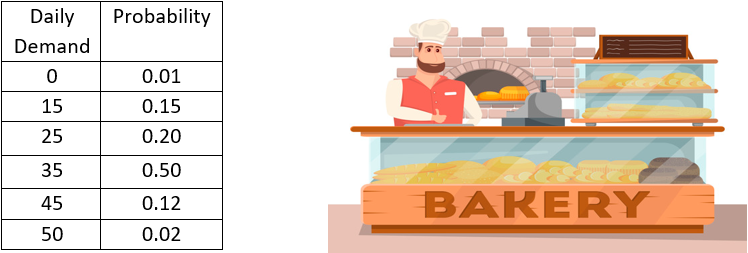
A bakery keeps stock of popular brand cakes. Daily demand on past experience is given. Consider the following sequence of random number: 48, 78, 09, 51, 56, 77, 15, 14, 68 & 09. Using this sequence simulate the demand for next 10 days. Find the stock situation if the owner of the bakery decides to make 35 cakes every day.