What is Huffman Coding?
- It is a compression technique.
- It is used to reduce the size of data or messages.
- The data is compressed to reduce the size when we want to transmit data in the network to minimize the cost of transmission.
Let's apply this algorithm to a problem.
Problem: Suppose we have a message with a length of 20.
Message: BCCABBDDAECCBBAEDDCC
- The length of this message is 20
- We need ASCII code to transmit this data
- ASCII code is 8 bits per character
For 'A', the ASCII code is 65 = 01000001
For 'B', the ASCII code is 66 = 01000010
For 'C', the ASCII code is 67 = 01000011
For 'D', the ASCII code is 68 = 01000100
For 'E', the ASCII code is 69 = 01000101
If we want to send the message with the ASCII code of each character, the size will be 8 * 20 =160 bits.
So, we can use our own code rather than use the ASCII code or 8 bits code.
Fixed Size Coding
- We can use 3 bits instead of 8 bits as we have only 5 characters in our message.
- We define the length based on the number of characters in the message.
- For 5 characters, we can use 3 bits code as we can have a 2^3 =8 combination of binary
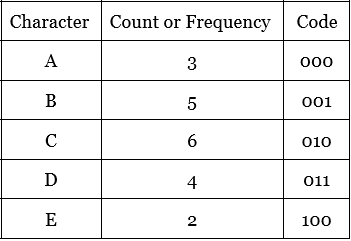
The size of the message = 20 * 3 = 60 bits
We have to send the table with the data so the receiver can decode the message according to our coding method (Character + Code).
The size of the table = Total bit required for representing the characters + Binary bits of code = 5 * 8 + 3 * 5 =40+15 = 55 bits
Total size of the message= 60 bits + 55 bits = 105 bits
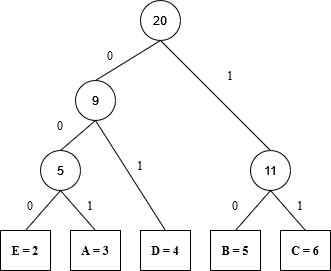
What if we have to reduce more? So, here we have "Huffman Coding"
Message: BCCABBDDAECCBBAEDDCC
We are applying the optimal merge technique here. If you are not gone through follow this Optimal Merge Pattern.
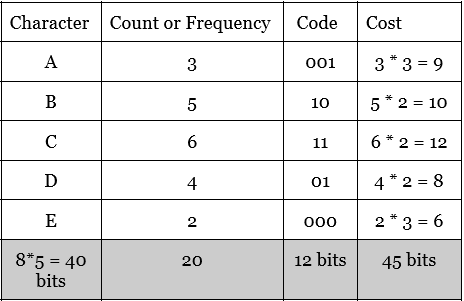
Total Cost= 40 + 12+ 45 = 97 bits !!